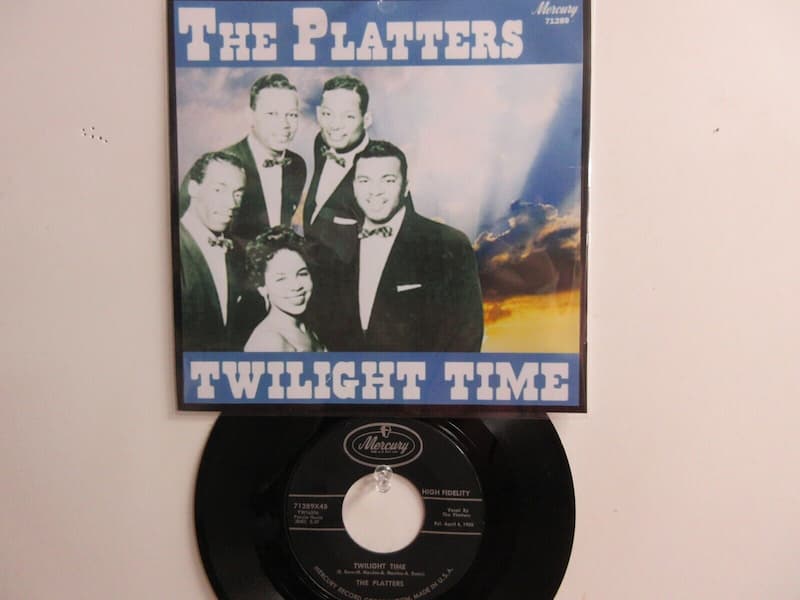
About The Song
“Twilight Time” drifted onto U.S. airwaves in April 1958, a velvet-soft ballad that showed The Platters could make romance feel both intimate and widescreen. Issued by Mercury (catalog 71289) and credited to lyricist Buck Ram with music from the Three Suns’ Morty & Al Nevins and Artie Dunn, the single runs a concise 2:47 and arrived as the group’s doo-wop-to-pop crossover was in full bloom.
The tune had a life before voices. The Three Suns cut it as an instrumental in 1944, followed by a Les Brown & His Band of Renown version in 1945; Ram later said he first wrote the words as a college poem before setting them to the Suns’ melody. When The Platters recorded it, they turned a dreamy motif into a cinematic pledge—Tony Williams floating lead over satin harmonies and a gently pulsing rhythm section that never hurries the line.
Arrangement-wise, “Twilight Time” is all about restraint. A clean guitar chime and brushed percussion leave air for Williams’s tenor, while the group’s stacked responses widen the frame without clutter. That spaciousness is why the record still feels modern on a single speaker: the production trusts the lyric and the melody to do the heavy lifting, and they do.
Lyrically, the song locates love in the day’s borderlands: “heavenly shades of night” falling, lovers “holding hands at twilight time.” It reads like a whispered rendezvous—no grand metaphors beyond the title’s glow, just everyday images arranged with care. The Platters specialized in that balance of poise and pulse; here, the words glide as naturally as the melody, and the chorus lands like a promise kept.
Radio answered immediately. In the United States, “Twilight Time” reached No. 1 on both the pop singles chart and the R&B best-sellers survey in April 1958, marking another pinnacle in the group’s Mercury run. Across the Atlantic, it climbed to No. 3 on the UK Singles Chart, extending the single’s reach well beyond doo-wop circles and into mainstream pop audiences who responded to its elegant simplicity.
The 7-inch pairing also helped. Backed with “Out of My Mind,” the record gave DJs a complementary flip while keeping attention on the A-side’s glow. Mercury’s U.S. pressings and international issues carried consistent credits—Ram and the Nevins brothers with Dunn—underscoring how unusual the cross-era collaboration was: a wartime instrumental reborn as a late-’50s vocal standard.
More than six decades later, “Twilight Time” retains its hush and its pull. You can hear why it’s stayed in rotation—from oldies radio to film trailers—whenever a director or programmer needs a song that feels like streetlights flickering on. The performance is modest, the craft exacting, and the feeling unmistakable: a small, perfect promise in the hour when the world goes quiet.
Video
Lyric
Heavenly shades of night are falling
It’s twilight time
Out of the mist, your voice is calling
‘Tis twilight time
When purple-colored curtains
Mark the end of the day
I’ll hear you, my dear, at twilight time
Deepening shadows gather splendor
As day is done
Fingers of night will soon surrender
The setting sun
I count the moments, darling
‘Til you’re here with me
Together at last at twilight time
Here in the afterglow of day
We keep our rendezvous beneath the blue
Here in the sweet and same old way
I fall in love again as I did then
Deep in the dark, your kiss will thrill me
Like days of old
Lighting the spark of love that fills me
With dreams untold
Each day I pray for evening
Just to be with you
Together at last at twilight time
Here in the afterglow of day
We keep our rendezvous beneath the blue
Here in the sweet and same old way
I fall in love again as I did then
Deep in the dark, your kiss will thrill me
Like days of old
Lighting the spark of love that fills me
With dreams untold
Each day I pray for evening
Just to be with you
Together at last at twilight time
Together at last at twilight time